Pé-de-Meia was created to reduce school dropout among low-income students in Brazil, offering structured incentives that reward steady attendance, yearly approval, and exam participation.
The program aims to keep teenagers in classrooms until graduation, easing financial pressure on families and strengthening future opportunities.
Program Snapshot and Purpose
Financial pressure pushes many teenagers to pause school prematurely, which harms long-term prospects.

Pé-de-Meia responds by providing conditional incentives that keep students in class and help them complete high school in Brazil, while similar student-savings initiatives may exist worldwide.
What the Program Is
Pé-de-Meia is a federal initiative that deposits incentives into a student account tied to enrollment, monthly attendance, annual approval, and participation in the final-year exam.
Initial cards were delivered at an official launch ceremony, and payments follow a schedule linked to each participant’s birth date.
Who the Program Serves
Eligibility targets low-income students aged fourteen to twenty-four enrolled in public high schools, including EJA students who meet age and income criteria.
Selection uses the government’s CadÚnico database, and early rollout prioritized households receiving Bolsa Família.
Eligibility and Priority Rules
Clear criteria avoid surprises and prevent missed payments during the school year.
Core requirements
To qualify, a student must be fourteen to twenty-four years old, be enrolled in a public high school, and belong to a family listed and updated in CadÚnico. EJA learners in the same age range also qualify when CadÚnico income thresholds are met.
Automatic selection
Separate applications are not required beyond school enrollment and CadÚnico. Matching occurs automatically through CadÚnico, and notifications follow if a student is selected in the active cycle.
What You Receive and When
Confusion around amounts wastes time; therefore, use this summary to understand each incentive and its timing.
| Criterion | Amount | Timing | Key condition |
| Enrollment bonus | R$ 200 | Once, after enrollment validation | Enrolled in public high school |
| Attendance incentive | 9 × R$ 200 (R$ 1,800/year) | Monthly, up to nine months | At least 80% attendance each eligible month |
| Annual savings deposit | R$ 1,000/year | After school-year approval | Approved for the academic year |
| ENEM participation (3rd year) | R$ 200 | After participation and approval | In 3rd year and approved in the year |
The enrollment bonus does not reduce other incentives. The total a student receives depends on meeting monthly attendance and annual approval conditions across the eligible years.
Conditions to Keep the Benefit
Maintain at least eighty percent attendance each eligible month to trigger the monthly installment. Achieve annual approval to unlock the savings deposit credited after the school year ends.
In the third year, participate in ENEM after passing the year to receive the exam incentive. Keep CadÚnico data updated to avoid eligibility conflicts during periodic checks.
Respond promptly to any school or program communication to prevent administrative holds.
Payment Access and Withdrawal
Access rules differ for monthly cash flow and long-term savings, in turn shaping when funds become available.
Account and Card
An account in the student’s name is opened automatically to receive the incentives. Notifications specify how to access the card and digital channels associated with the account.
What Can Be Withdrawn Immediately
Amounts tied to enrollment validation and monthly attendance can be withdrawn as soon as they are credited according to the calendar.
What is Held Until Completion
Savings deposits and the ENEM incentive are released only after issuance of the high school completion certificate. That structure protects the long-term purpose of the program and encourages on-time graduation.
Step-by-Step Enrollment Path
Many students overcomplicate the start, which means the most straightforward path is often the most reliable.
- Confirm school enrollment: Secure enrollment at a public high school or EJA unit under the state or municipal network.
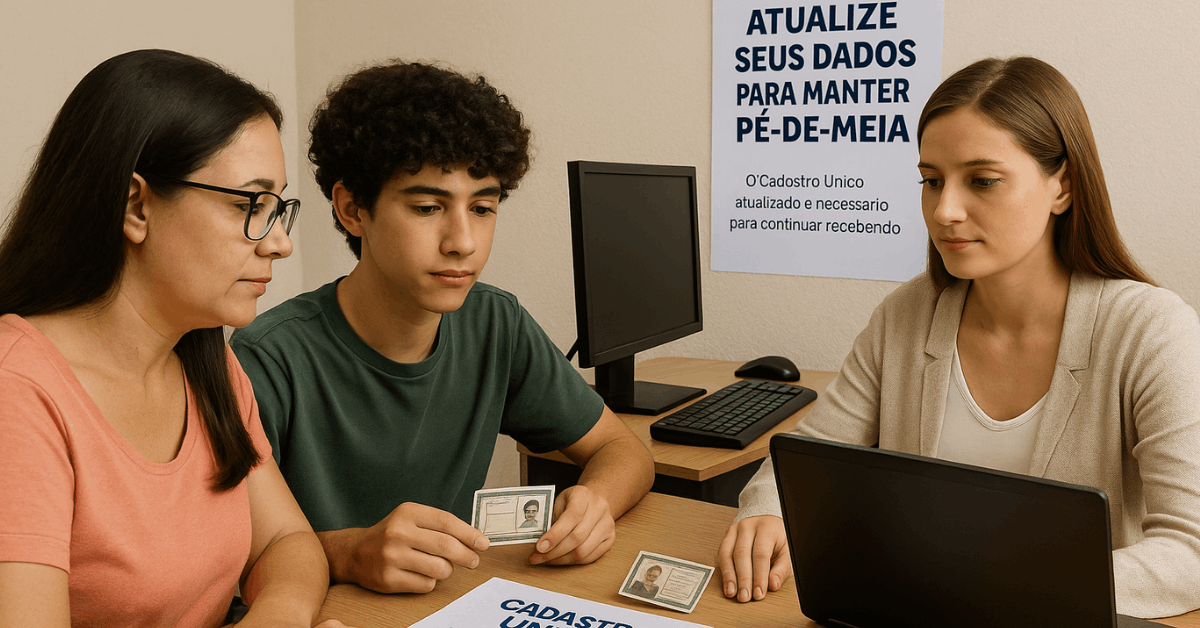
- Update CadÚnico: Visit the responsible social assistance service to confirm that family data, composition, and address are current.
- Track notifications: Monitor messages from the school and official channels regarding selection, payment calendar, and card pickup.
- Meet attendance targets: Keep at least eighty percent attendance monthly and resolve absences quickly with the school office.
- Close the school year approved: Focus on passing the grade to release the annual savings deposit and maintain eligibility for the next cycle.
- Third-year action: Participate in ENEM after passing the year to receive the designated exam incentive.
Termination, Suspension, and Reinstatement
Assumptions about permanence can be risky, that way students should watch for triggers that stop payments.
Events that stop or end the benefit:
- Formal dismissal request by the student or guardian submitted to the managing body.
- Two consecutive failures recorded in school records during the eligible period.
- The education network recognizes school dropout or confirmed evasion.
- Loss of eligibility between years, including leaving the public network or aging out after twenty-four.
- Becoming a single-person family under CadÚnico rules when that status conflicts with the program’s criteria.
- Verified fraud or irregularity identified during audits or cross-checks.
Can Payments Resume Later?
Reinstatement may occur when the cause was a temporary loss of eligibility, such as a data lapse in CadÚnico or a switch back to the public network.
Cases involving fraud or confirmed irregularity are irreversible and block future participation even if the criteria are later met.
Calendar, Launch Notes, and Practical Tips
Mixed timelines often cause planning errors; as a result, careful attention to scheduling prevents missed installments.
Payment Calendar
Disbursements follow a calendar tied to the student’s month and day of birth. Schools and official channels announce the detailed schedule before each cycle, and payments are posted to the designated account accordingly.
Launch Reference
Public authorities announced the initial cycle alongside the delivery of payment cards to representative students, while teachers, lawmakers, and program leaders attended the event to mark the start of payments.
Practical Tips to Avoid Delays
Keep proof of enrollment, attendance summaries, and grade results accessible for any verification requests during the year. Confirm contact details in school and CadÚnico records to ensure messages about eligibility or card pickup reach the correct person.
Resolve absences that exceed monthly limits immediately to avoid losing the corresponding installment in that period.
Retain graduation documentation to trigger the release of savings and ENEM amounts without additional back-and-forth.
Conclusion
Pé-de-Meia strengthens the link between education and opportunity by easing financial barriers that often deter students from continuing their education.
Its structure of enrollment, attendance, approval, and graduation incentives ensures support follows students through each stage until completion.
Clear rules and automatic selection keep the program accessible, while long-term deposits protect the goal of finishing high school. In practice, it serves as a safety net and motivator, helping more teenagers secure a diploma and expand their future options.